Characterization of yellow pea (Pisum sativum L.) genotypes for performance (agronomic and quality) and stability across environments
USDA Agricultural Research Service | Washington State University
Partner institutions

USDA Agricultural Research Service
Multiple sites, USA
The chief in-house scientific research agency of the U.S. Department of Agriculture, conducting research across crop science, food safety, and agricultural technology nationwide.

Washington State University
Pullman, WA, USA
A public land-grant research university based in Pullman, Washington, home to the USDA-ARS Western Wheat Quality Laboratory.
How Vibe analyzers were used
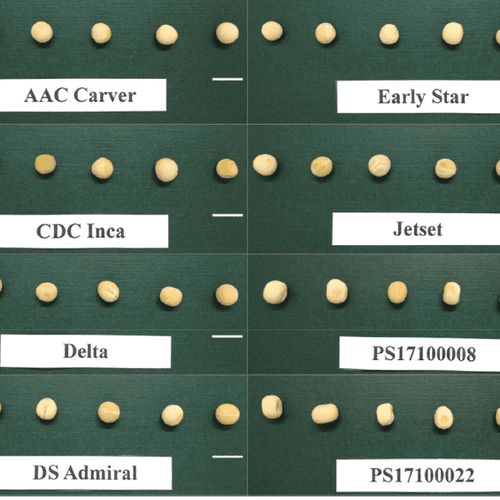
Thousand-seed weight of 21 yellow pea genotypes across Washington test environments was measured with a Vibe QM3i Grain Analyzer, feeding an analysis of agronomic performance, quality, and genotype-by-environment stability.
Study overview
This study characterized 21 yellow pea genotypes grown at Fairfield and Pullman, Washington in 2020 and 2021 for agronomic and quality performance and stability across environments. Thousand-seed weight (TSW) of each plot was determined using a Vibe QM3i Grain Analyzer, alongside seed yield and a suite of protein isolate and starch-byproduct quality parameters. Seed yield and seed weight dropped by over 61% and 11%, respectively, in 2021 compared to 2020. About 17-20% of flour was recovered as protein isolate, with a protein recovery rate of 66-69%, and about 61-64% was converted to a starch-rich byproduct. Heritability was fairly high for seed weight and protein isolate yield but low for seed yield and functional properties, and some genotypes combined favorable seed yield with either seed weight or flour protein content.
Topics and keywords
Related crop analysis
Bibliographic details
Year: 2023
Publication: Cereal Chemistry
DOI: 10.1002/cche.10677
Institutions: USDA Agricultural Research Service, Washington State University
More research using Vibe
Explore additional studies applying Vibe analyzers in grain and seed phenotyping workflows.