Identifying and overcoming challenges in scaling up malted rice for commercial malting and brewing
University of Arkansas
Partner institutions

University of Arkansas
Fayetteville, AR, USA
A public land-grant research university in Fayetteville, Arkansas, with long-standing programs in agricultural and food science.
How Vibe analyzers were used
A pilot-scale follow-up to the team's earlier rice malting study, scaling malting from lab batches to ~150 kg pilot production across two malthouses and six breweries, with kernel length and width measured on a Vibe QM3 grain analyzer.
Study overview
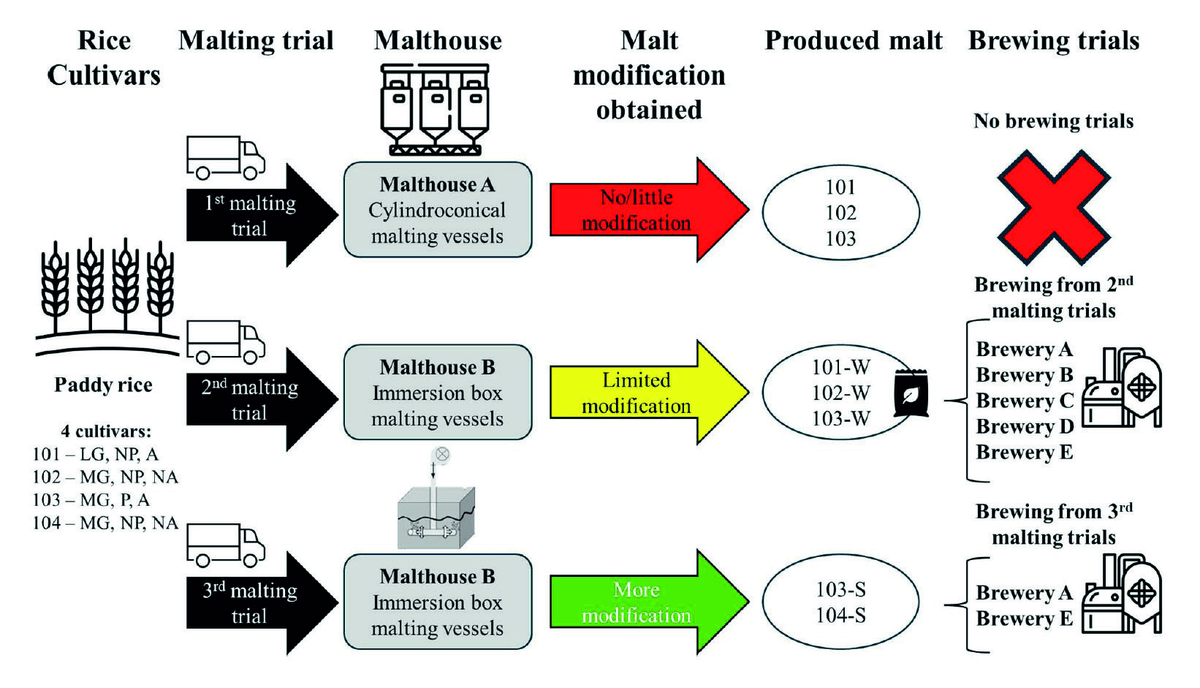
Barley has long been the primary grain used for malting and brewing, but climate concerns and gluten-free demand motivate exploring rice as an alternative. This study scaled malting from laboratory (~0.5 kg) to pilot production (~150 kg) across two malthouses and six breweries. Rice exhibited distinct characteristics including lower germination energy and reduced water uptake capacity, necessitating equipment modifications. Extract yields ranged 38-64% with enzymatic profiles distinct from barley, and testing confirmed that adequate malt modification or the use of exogenous enzymes was essential to prevent processing issues. Sensory evaluation revealed varied flavor attributes across rice varieties. Kernel length and width were measured with a Vibe QM3 grain analyzer (Vibe Imaging Analytics, Inc., Santa Cruz, CA, USA). The authors conclude that malted rice offers a promising pathway to diversify brewing raw materials.
Topics and keywords
Related crop analysis
Bibliographic details
Year: 2026
Publication: BrewingScience
DOI: 10.23763/BrSc26-02guimaraes
Institutions: University of Arkansas
More research using Vibe
Explore additional studies applying Vibe analyzers in grain and seed phenotyping workflows.